Research Brief
Canada Retail Sales
November 2026

Canadian Retail Spending is Losing Momentum Heading Into October
Higher fuel prices mask soft underlying spending. Canadian retail sales rose 0.8 per cent monthly to $75.3 billion in September, largely because households paid more at the pump. Fuel receipts rose more than four times as fast as fuel volumes, which explains why the headline gain looked stronger than the 0.1 per cent increase in overall sales volumes. Modest gains at auto dealers also supported the headline, while core sales edged up just 0.1 per cent on the month. The spending mix suggests households were selective with discretionary purchases. General merchandise and clothing retailers gained ground, but those gains were largely offset by weakness elsewhere, including at furniture and building supply stores. A subdued resale market likely reduced move-related purchases, while elevated financing costs may have encouraged households to defer larger renovation projects.
October weakness gives the Bank room to pause. The advance estimate points to a 1.5 per cent decline in October retail sales, which would more than reverse September’s gain. Lower gasoline prices likely explain part of the drop, while weak consumer confidence and a rising share of businesses reporting insufficient demand suggest the slowdown extends beyond fuel. Retail volumes still grew 1.0 per cent in the third quarter, but the October estimate points to a softer start to the fourth. Oil prices near a three-month low also ease some of the near-term inflation pressure that prompted October’s rate hike. Together, softer spending and lower oil prices give the Bank of Canada scope to hold its policy rate at 2.5 per cent through year-end and reassess in early 2027.
Commercial Real Estate Outlook
Vancouver retail rents outpace provincial spending. National retail sales were up 7.5 per cent year over year in September. In Ontario, sales rose 8.4 per cent, compared with 5.1 per cent in British Columbia. Yet third-quarter asking rents in Vancouver increased 4.6 per cent annually, more than twice Toronto’s 1.9 per cent gain, even as Vancouver’s vacancy rate was slightly higher at 2.6 per cent versus 2.4 per cent. Vancouver added just 5,100 square feet of retail space during the quarter, highlighting limited options for tenants seeking new locations. With little new space coming to market, owners with well-located storefronts may still have room to raise rents, even as spending growth slows across the province.
Housing weakness raises leasing risks for home-oriented centers. September’s split in discretionary spending has implications for properties with large-format tenants. Clothing sales rose 0.8 per cent, while furniture and building materials sales fell 1.9 per cent and 1.3 per cent, respectively. A subdued resale market can delay move-related furniture purchases, while higher borrowing costs may prompt households to scale back or postpone renovations. If weakness persists, home-related retailers may become more cautious about adding stores, narrowing the pool of tenants available to backfill large units in power centers. Apparel’s relative resilience offers some support for smaller spaces in well-located malls, particularly where tenants can draw on steady foot traffic.
.

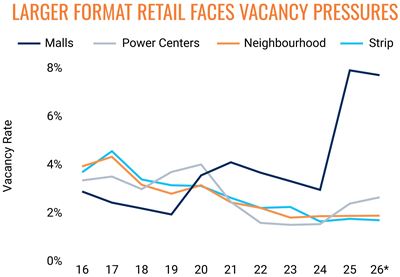
* Through 3Q; ** Forecast provided by Oxford Economics | Sources: Altus Data Solutions;
Capital Economics; CoStar Group, Inc.; Oxford Economics; Statistics Canada
TO READ THE FULL ARTICLE