Research Brief
Canada Industrial
November 2026

Industrial Sector Remains in Recovery Mode Despite Near-Term Hurdles
Activity weakened amid escalating trade tensions. Manufacturing sales held broadly steady in September, with a 10 per cent increase in petroleum and coal products offsetting declines of 9.6 per cent in primary metals and 7 per cent in wood products. Beneath the stable headline figure, however, shipment volumes fell 1.5 per cent, the sharpest monthly decline since January 2026, indicating that higher prices supported nominal sales amid weakening underlying activity. The slowdown followed the breakdown of CanadaU.S. trade negotiations in late summer, as higher U.S. tariffs continued to pressure the manufacturing sector. The moderation in manufacturing activity, alongside softer labour and housing market conditions in late summer, points to slowing economic momentum heading into the final quarter.
Outlook remains positive, particularly over the long run. In the near term, the manufacturing sector is expected to remain resilient. The latest U.S. tariffs remain limited in scope, with about 80 per cent of goods continuing to cross the border duty-free. Exemptions introduced in October will also help contain their impact on Canadian manufacturers. Further upside could emerge from the recent resumption of negotiations, with a potential Canada-U.S. trade agreement easing uncertainty and strengthening manufacturing activity. Over the longer term, continued trade diversification should provide an additional buffer against external shocks. With exports to non-U.S. markets now more than 55 per cent above their 2023 level, manufacturers are becoming less reliant on any single export market, helping strengthen the sector’s resilience to future trade disruptions.
Industrial leasing momentum stayed robust entering year-end. With net absorption through the first three quarters already exceeding last year’s total, the industrial sector is positioned to finish the year strong. Space demand has strengthened nationwide, with particularly notable gains in Calgary, Montreal, Ottawa, and Vancouver. Renewed late-summer trade policy uncertainty could temper this momentum in the final quarter. Still, the recovery is expected to regain traction thereafter as businesses continue to adjust to the post-tariff environment. As a result, national vacancy is projected to end the year 20 basis points below its 2025 level, marking its first annual decline since 2021.
Investment activity under short-term pressure. With borrowing costs facing renewed upward pressure, investors may adopt more conservative underwriting assumptions, widening bid-ask spreads and potentially putting upward pressure on cap rates. Higher financing costs could also further constrain speculative development, reinforcing a more disciplined supply outlook. However, improving fundamentals are likely to help offset some of these pressures, with recovering space demand, moderating construction, and stabilizing vacancy supporting stronger income growth prospects. As a result, while higher borrowing costs may limit near-term transaction activity and price appreciation, Canada’s industrial sector remains well positioned, given its improving supply-demand balance and favourable long-term outlook.

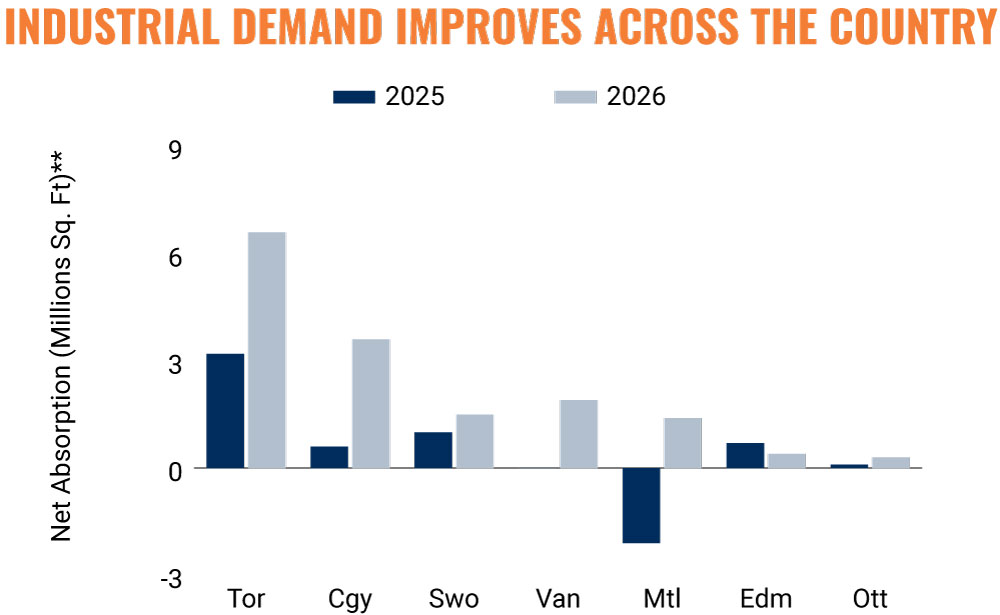
* Trailing 12-month total through September.
Sources: Altus Data Solutions; Capital Economics; Oxford Economics; Statistics Canada
TO READ THE FULL ARTICLE