Research Brief
Canada Employment
November 2026

Labour Market Continues to Soften as Lower Yields Offer CRE Relief
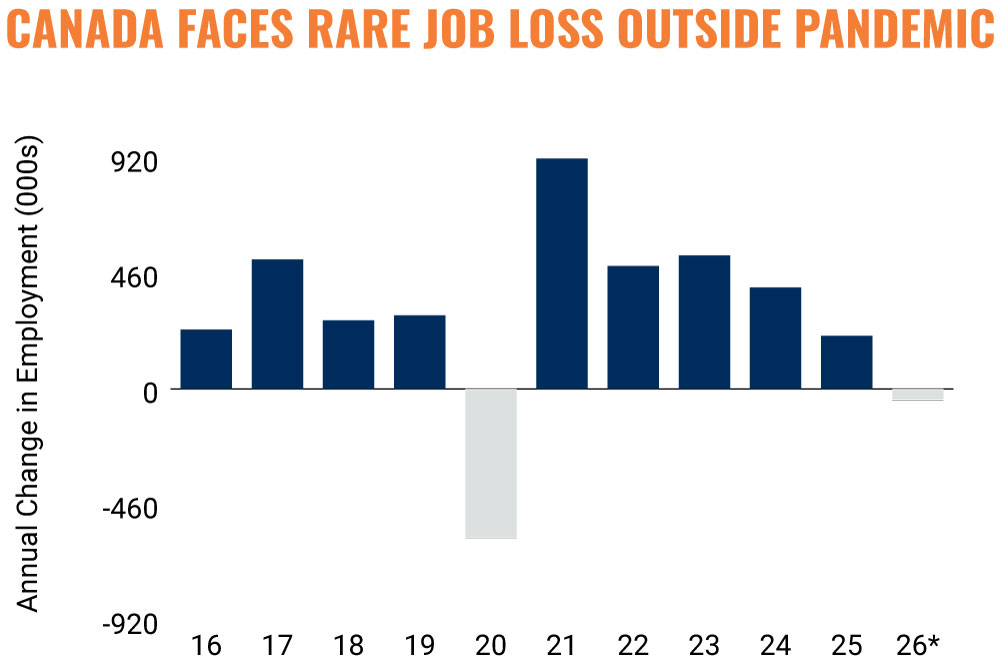
Employment contracts for a third consecutive month. Canada shed 4,700 jobs in October, following losses of roughly 42,000 in August and 68,000 in September, bringing the cumulative decline to approximately 115,000 positions. Private-sector employment fell by 52,500 positions, with gains in public-sector employment cushioning the overall decline. Wholesale and retail trade led sectoral losses, while transportation and warehousing also contracted, partially offset by stronger construction hiring. The unemployment rate rose 20 basis points to a six-month high of 6.7 per cent, signalling renewed labour market slack. Permanent employees’ wage growth also slowed to 2 per cent annually, reinforcing evidence that softer hiring and subdued economic activity are limiting household income growth and could constrain consumer spending in the months ahead.
Labour market challenges the case for further tightening. The Bank of Canada has prioritized upside inflation risks from elevated energy prices, prompting October’s increase in the overnight rate to 2.5 per cent. However, three consecutive employment declines, moderating wage growth, and weak GDP readings in August and September suggest domestic demand remains fragile. These conditions raise the risk that the Bank began tightening before the economy could sustain higher borrowing costs, particularly as trade uncertainty continues to weigh on investment and hiring. Energy prices will remain central to near-term decisions, but growing spare capacity may limit broader inflation pressures. Further precautionary increases remain possible, although the evidence increasingly favours a short tightening cycle.
Commercial Real Estate Outlook
Falling bond yields offer some financing relief. Government bond yields have retreated after rising on inflation concerns, as U.S. midterm results shift expectations or trade and energy policy. Democratic control of Congress could bring greater scrutiny of President Trump’s tariffs and Iran war spending, encouraging hopes of de-escalation and lower energy costs. Canadian five-year yields fell roughly 30 basis points between mid-October and early November, easing a commercial mortgage pricing benchmark. Energy-driven volatility remains likely, but borrowing-cost peaks may be behind us, improving underwriting and helping buyers and sellers reach agreement. This relief follows a modest third-quarter slowdown in investment dollar volume after a broad recovery since mid-2024, although preliminary figures exclude Alberta.
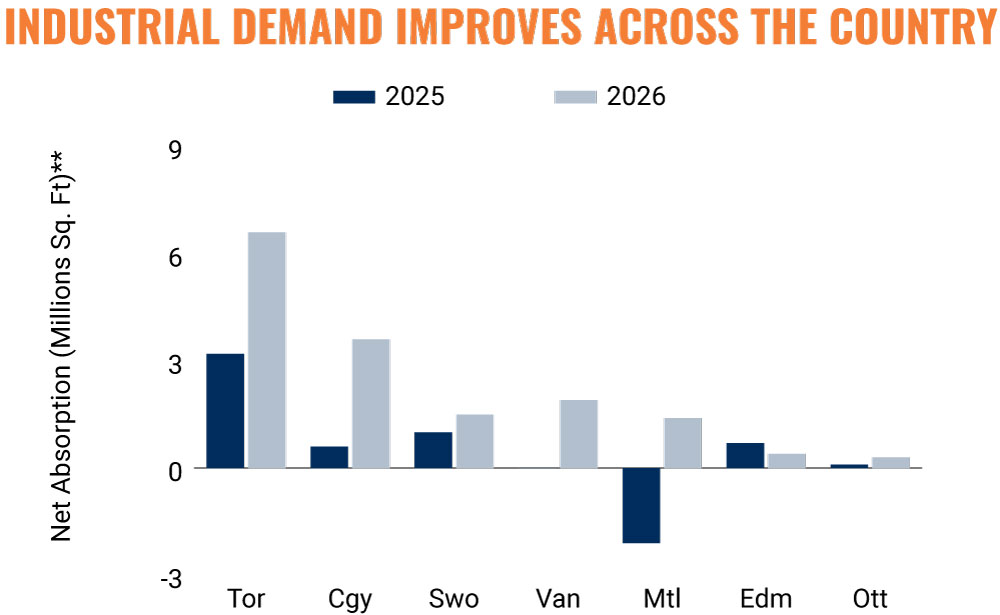
Industrial demand holds firm despite emerging employment risks. October’s losses in wholesale and retail trade and transportation and warehousing point to potential headwinds for industrial leasing. However, property fundamentals remained relatively healthy entering the fourth quarter. Year-to-date positive net absorption is up roughly 360 per cent as of the third quarter compared with last year, while vacancy is down 30 basis points year over year to 3.4 per cent. Demand improved across almost all submarkets, with Calgary, Montreal, and Toronto leading the way. Softer hiring could temper further gains, but restrained construction will help limit vacancy pressure.
* Year to date through October; ** Year to date through 3Q | Sources: Altus Data Solutions;
Capital Economics; CoStar Group, Inc.; Oxford Economics; Statistics Canada
TO READ THE FULL ARTICLE