Research Brief
Retail Sales
October 2026

Necessity Retailers Favored as Persistent Inflation Impacts Consumer Behavior
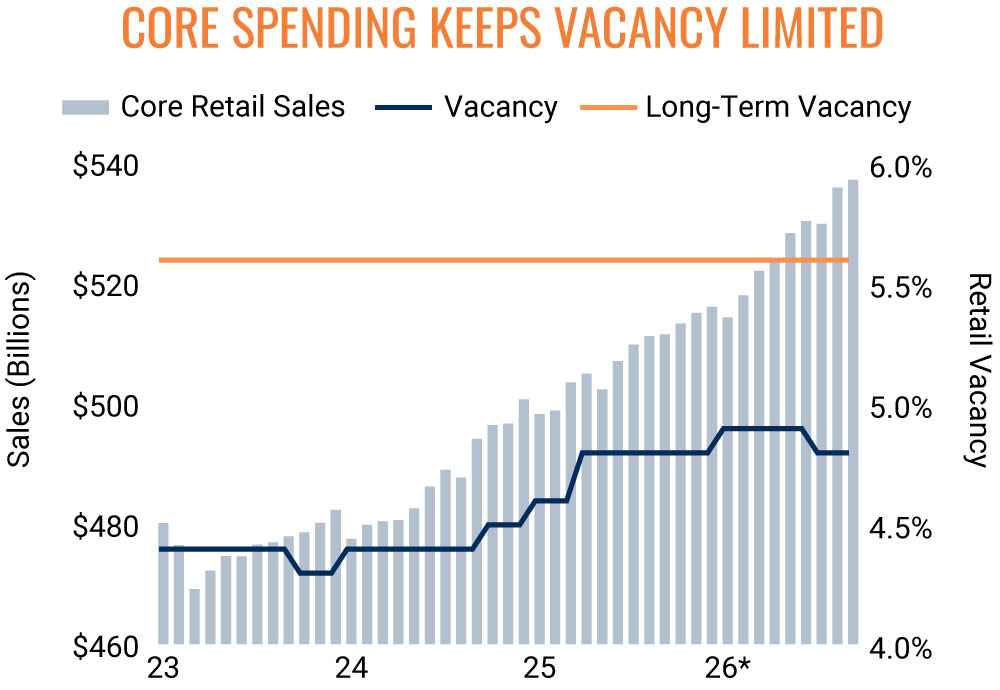
Stretch of resiliency is being tested. Core retail sales reached a record high in September; however, consumer spending was unchanged in real terms after accounting for inflation. This lack of growth suggests elevated gas prices are weighing on household budgets, with consumers pulling back on some discretionary purchases while prioritizing necessities. Nevertheless, core sales rose 5.0 percent year over year in September, with five retail categories logging gains ranging from 7.0 to 10.9 percent. This dynamic has positive implications for future retail property performance amid limited construction, sub-5 percent vacancy, and record asking rent. Still, headwinds exist that will affect retailers’ profitability and potentially consumer prices. The producer price index rose 6.3 percent annually last month, stoking concerns about price spillover to consumers amid still-elevated inflation. Concurrently, just 29,000 jobs were added last month, which may weigh on future retail sales growth. Fortunately, employment remains firmer than in late 2025, and the labor market is in a low-hire, low-fire state, which should reinforce consumer spending.
Supermarkets well positioned. Grocery spending hit a record $77.1 billion in September, up 0.6 percent monthly in real terms. The recent gain was not inflation-driven, as the food-at-home price index fell 0.1 percent last month, following similar declines over the prior two months. Spending at supermarkets is helping backfill available space by regional and ethnic grocers, supporting a 2.7 percent vacancy rate.
Consumers still value dining out. Restaurants and bars noted the largest sales gain among retail categories last month despite a broader pullback in discretionary spending and a modest increase in food-away-from-home prices. Additionally, the segment accounted for 17.3 percent of all core retail sales in September, the highest level since immediately before the pandemic. These dynamics are driving demand for fast casual and traditional dining space among expanding chains, with vacancy across these property types at 3.0 percent entering the fourth quarter.
Reliance on credit may drive holiday sales. Despite mounting pressure on household budgets, the outlook for holiday spending is optimistic, with several industry groups forecasting year-over-year increases in the low-4 percent range. Consumers, however, may rely on less traditional forms of credit, such as buy-now, pay-later options, to fund holiday shopping, which will have implications for consumer spending beyond this year.
Key Takeaways
- Core retail sales, which exclude motor vehicle and gas sales, rose 0.3 percent in September and 5.0 percent year over year. Last month’s gain, however, coincided with a 0.3 percent uptick in core CPI, indicating spending was essentially unchanged in real terms.
- Many households are prioritizing necessities while also setting aside some of their budget for dining out. As such, the restaurants and bars category recorded the largest monthly increase in spending. Concurrently, spending at grocery stores reached a record mark.
- Consumers may rely on less traditional forms of credit, such as buy-now, pay-later options, to fund their holiday shopping in the coming months.
0.3% |
5.0% |
|
Rise in Core Retail Sales (Monthly) |
Rise in Core Retail Sales (Year Over Year) |
* Through 3Q, based on preliminary data
Sources: Marcus & Millichap Research Services; Bureau of Labor Statistics; Census Bureau;
CoStar Group, Inc.; Deloitte; National Retail Federation
TO READ THE FULL ARTICLE