Research Brief
Employment
October 2026

Rental Demand Holds Up Even as Slow Hiring Weighs on Recent College Graduates
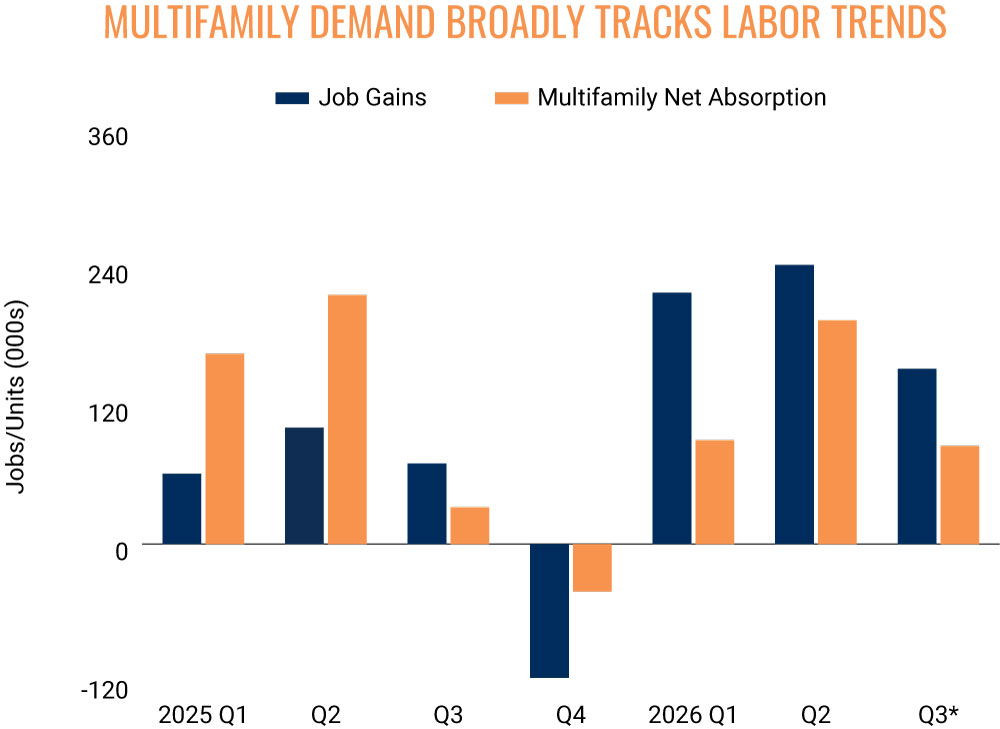
Labor demand stays soft. September job gains slowed to 29,000, while the prior two months’ totals were revised down by a combined 60,000. Recent hiring has been driven by sectors in which employees historically slot into the renter pool. Healthcare added 33,000 jobs, while manufacturing and construction each added roughly 10,000. While the labor market is in a low-hire, lowfire state, employment remains firmer than in late 2025, supporting apartment demand and consumer spending. Preliminary third-quarter data points to apartment absorption more than doubling from a year earlier, lowering vacancy by 10 basis points, while retail sales remained resilient. These dynamics have positive implications for future multifamily and retail property performance amid a broad pullback in both sectors’ construction pipelines.
Young renters face a tougher job market. Labor force participation rose to 61.8 percent last month, with the slight increase in unemployment driven largely by new and returning entrants as layoffs declined. This dynamic highlights challenges facing recent college graduates, whose unemployment rate remains above 5 percent as firms retain workers and hire more selectively. Because this cohort represents a large share of the renter pool, weaker entry-level hiring may be hindering a key source of apartment demand. Recent research also estimates that broader adoption of remote work can explain 64 percent of the post-pandemic rise in unemployment among young college graduates, as these workers require more in-person training and mentorship. Encouragingly, nationwide office visits rose by a reported 6.2 percent year-overyear in August, which could help ease this hiring barrier.
Higher rates cool leasing and hiring. Recent monetary tightening and higher long-term interest rates could prolong the low-hire labor market. Restrictive policy typically works first through fewer vacancies and slower hiring rather than layoffs, which may help explain current conditions. Employers so far have absorbed higher financing costs without broad job cuts, but sustained rate pressure could still curb hiring and expansion plans. Capital-sensitive industries such as construction, manufacturing, and select whitecollar sectors may face the greatest drag, potentially weighing on office and industrial leasing while slowing development activity.
Wage gains slow but still above prior norms. Average hourly earnings growth slowed to 3.0 percent year-over-year in September, the weakest pace since late 2019. With inflation still elevated, real incomes have weakened. Even so, wage growth averaged roughly 2.5 percent during the 2010s, suggesting current gains remain relatively healthy, which should help reinforce consumer spending.
Key Takeaways
- Hiring stayed subdued, but employment is holding up better than 2025, supporting apartment vacancy below the prior five-year average and record core retail sales.
- A key renter cohort remains pressured as recent-college-graduate hiring stays weak amid low hiring and persistent remote work, though rising office attendance could help improve entry-level opportunities.
- Elevated borrowing costs could extend cautious hiring and corporate expansion plans, with the greatest risk to office, industrial, and development activity.
- Wage growth has slowed to its weakest pace since 2019, but remains above the 2010s average, which may continue to support household spending.
612,000 |
66,000 |
|
Jobs Added Year to Date Through September |
Average Monthly Job Gain, Past Six Months |
* Third-quarter multifamily net absorption based on preliminary data.
Sources: Marcus & Millichap Research Services; Bureau of Labor Statistics; CoStar Group, Inc.;
Federal Reserve Bank of New York; Placer.ai; RealPage, Inc.; U.S. Census Bureau
TO READ THE FULL ARTICLE