Research Brief
Economic Durability
October 2026

Durable Economy Creates Opportunity for Commercial Real Estate
Economic crosscurrents shape nuanced outlook. Although energy costs, inflation, rising interest rates, weak consumer sentiment, and sluggish job creation remain key challenges, the U.S. economy continues to show resilience.
- Despite these pressures, retail sales continue to rise, even after inflation adjustments, highlighting consumer durability.
- U.S. GDP growth remains on a positive trajectory, with annualized gains of 2.1 percent in the first quarter of 2026 and 1.5 percent in the second quarter of 2026.
- Full-year 2026 GDP growth is forecast near 2 percent, roughly in line with the economy’s long-term average growth rate.
- Higher financing costs are creating pressure on transaction activity across property sectors.
- Recession risk remains relatively low, with the consensus probability over the next 12 months at 25 percent, reinforcing the U.S. economy’s resilience.
Key fundamentals support economic growth. Business investment, healthy corporate conditions, and strong household balance sheets continue to support the U.S. economy.
- Business capital expenditures remain a key driver of economic growth, with investment in AI and tech contributing an estimated 50 to 100 basis points to GDP growth over the last several quarters, with underlying economic growth still near 1 percent when excluding those investments.
- The ISM Manufacturing and Services indexes are both near 55, signaling continued expansion across both sectors and placing manufacturing activity near its highest level since 2022.
- Corporate profits have reached a record high, reinforcing the underlying strength of the current business environment.
- Total household savings, including money market mutual funds, remain at record levels, providing a substantial financial cushion for U.S. consumers.
- Household debt as a share of income is at its lowest level in more than 20 years, while real disposable personal income is near record highs in aggregate and per capita terms.
- Despite strong overall household finances, considerable disparities across wealth brackets may be contributing to persistently weak consumer sentiment.
Long-term commercial real estate remains growth-supported. Economic resilience provides a supportive backdrop for commercial real estate, even as investors navigate ongoing and future economic and market headwinds.
- Despite areas of uncertainty, the underlying strength of the U.S. economy suggests that the risk of a major economic setback remains relatively low.
- Economic durability should support positive long-term space demand, although periodic challenges are likely.
- Market-level performance may vary, with some metros facing greater economic and real estate headwinds than others.
- Over the longer term, continued economic growth should support increased demand for space across industrial, retail, multifamily, self-storage, hotel, and even office properties.
- Commercial real estate investors focused on creating value within their properties, improving operating efficiency, and positioning for long-term growth should benefit from durable economic forces.
- While today’s economic headwinds remain important considerations, CRE is ultimately a long-term investment, where the more durable trends gain prominence.
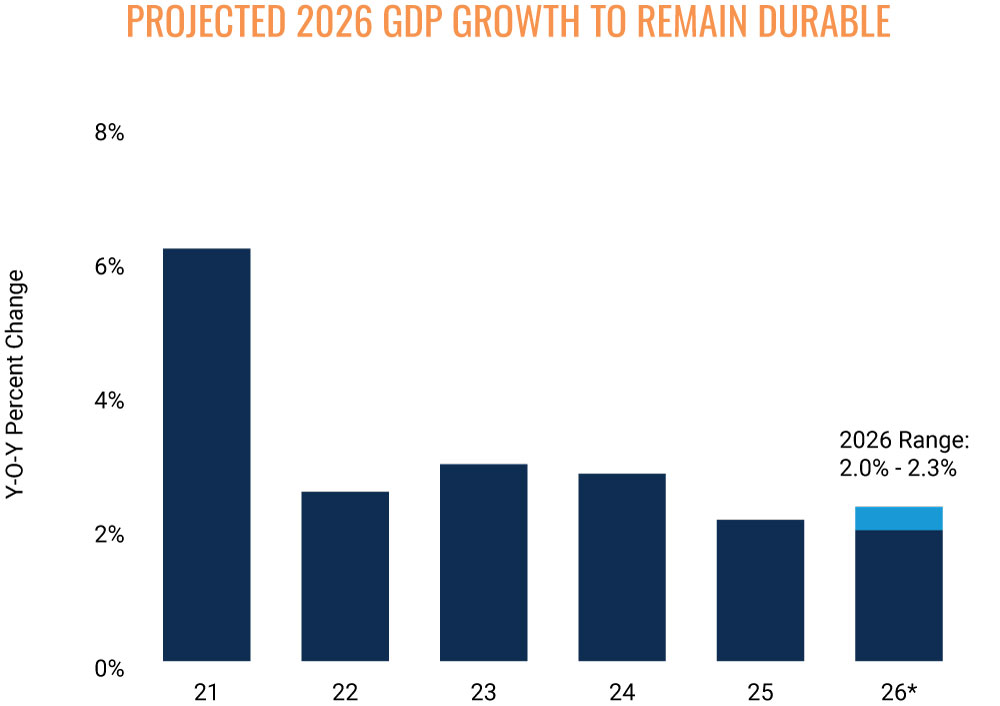
* Forecast Sources: Marcus & Millichap Research Services; Blue Chip Economic Indicators; Bureau of Economic Analysis; Federal Reserve; Institute for Supply Management; Office of Financial Research; U.S. Census Bureau; Wall Street Journal
TO READ THE FULL ARTICLE