Research Brief
Gross Domestic Product
August 2026

Private Investment Fuels Economic
Growth, Bolstering Select Property Types
Strong consumption aided retail properties. Despite weakness in several other GDP components, consumer spending stood out in the second-quarter reading. Personal consumption expenditures contributed 2.1 percentage points to real GDP growth, marking one of the strongest quarterly contributions since the beginning of 2025. This aligns with recent improvement in retail sector fundamentals, as U.S. retail net absorption reached 8 million square feet over the past three months, reversing the net space relinquishment in the first quarter. The 5.7 percent increase in core retail sales in the last 12 months ended in July also points to continued spending momentum. Still, this pace may moderate through the remainder of the year, as some second-quarter strength likely reflected event-driven demand tied to travel, dining, and entertainment, including the World Cup.
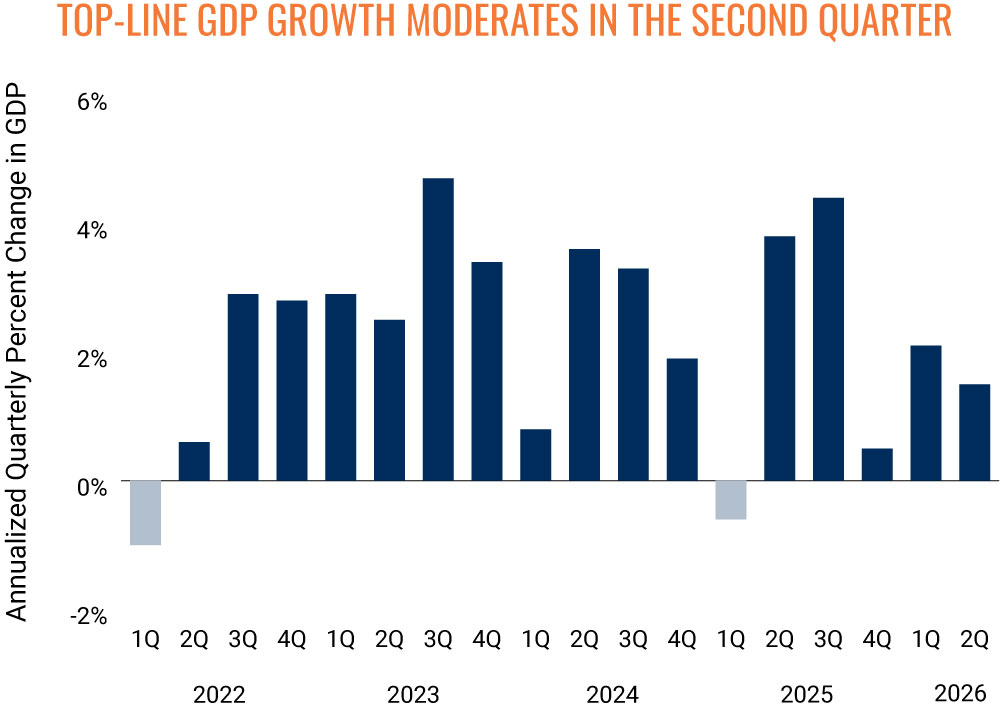
Steady fixed investment supports industrial outlook. Gross private domestic investment added 0.5 percentage points to second-quarter GDP growth, down from 1.4 percentage points in the first quarter. Still, the slowdown was largely tied to inventories rather than fixed investment. Nonresidential fixed investment added 1.1 percentage points, slightly below the last quarter, while private inventories subtracted 0.7 percentage points after adding 0.2 percentage points in the first quarter. The Bureau of Economic Analysis noted that wholesale trade led the inventory decline, suggesting a volatile adjustment within supply channels rather than a broad pullback in capital spending. With industrial vacancy appearing to have peaked in late 2025 and new supply pressure easing in 2026, fundamentals could improve modestly, especially if reshoring activity begins to translate into more space demand.
- Real GDP growth slowed in the second quarter, but underlying demand from households and businesses appeared stronger than the headline rate suggested.
- Core PCE growth eased from the first quarter but remained materially above the Fed’s 2 percent target.
- Stronger consumer activity supported improved retail absorption, especially as supply pressure eases this year. Still, inflation-driven budget pressures could limit further gains over the coming quarters
- Inventory swings masked resilient fixed investment, while easing supply pressure positioned industrial fundamentals for modest improvement.
1.5% |
3.3% |
|
Annualized Rate of |
Year-Over-Year Change in |
Sources: Marcus & Millichap Research Services; Bureau of Economic Analysis;
U.S. Census Bureau
TO READ THE FULL ARTICLE