Research Brief
Canada Retail Sales
August 2026

Retail Spending Rebounds as Investment Activity Gradually Strengthens
Consumer spending jumps to close out the second quarter. Canadian retail activity strengthened considerably in June, with inflation-adjusted sales up 1.5 per cent — the largest monthly gain since December 2024. In nominal terms, sales rose 0.6 per cent, while excluding motor vehicles and gasoline stations, receipts rose a stronger 1.2 per cent. Gains were relatively broad-based, led by clothing and accessories, sporting goods, and building materials, while e-commerce sales surged 10 per cent amid the earlier timing of Amazon Prime Day. Despite June’s strong finish, retail sales volumes increased at a more moderate 1.8 per cent annualized pace during the second quarter, reflecting softer consumer spending earlier in the period.
Spending momentum is unlikely to alter the interest rate outlook. June’s rebound further suggests that economic activity is stabilizing after a softer period, supporting expectations of continued GDP growth through the second half of the year. However, early estimates point to a 0.8 per cent decline in retail sales in July, suggesting some of June’s strength was temporary, as Prime Day pulled some sales forward and higher gasoline prices constrained household purchasing power. As a result, consumption growth is likely to moderate rather than accelerate materially. This should reinforce the Bank of Canada’s ability to keep its overnight rate at 2.25 per cent, with improving economic conditions reducing the need for additional cuts while still-subdued demand limits pressure to begin tightening monetary policy
Commercial Real Estate Outlook
Retail properties benefit from where consumers are spending. June’s sales growth offers an encouraging signal for retail, with several discretionary and store-oriented categories recording meaningful gains. Clothing and accessory sales increased 3.1 per cent month-over-month, sporting goods rose 1.9 per cent, and building materials advanced 1.2 per cent, indicating that households remain willing to spend beyond essential categories despite economic uncertainty. While e-commerce recorded the largest increase, much of the 10 per cent surge reflected the temporary shift in Prime Day. More broadly, resilient discretionary spending should continue to support tenant sales and occupancy across well-located retail properties, particularly as limited construction keeps competitive space scarce.
Retail investment strengthens. Canadian retail transaction volume reached $7.3 billion over the 12 months ending in the second quarter, up 12 per cent from the comparable period a year earlier. Deal flow also improved, rising 14 per cent annually and approaching the elevated levels recorded earlier in the decade. While second-quarter volume moderated to $1.4 billion, transaction counts increased from the first quarter, highlighting continued liquidity across smaller and midsized assets. Improving financing conditions, greater price discovery, and resilient property fundamentals should continue to support investor demand for retail assets through the second half of 2026.

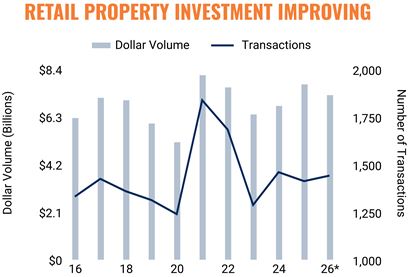
* Trailing-12-months through 2Q | Sources: Altus Data Solutions; Capital Economics;
CoStar Group, Inc.; Oxford Economics; Statistics Canada
TO READ THE FULL ARTICLE