Research Brief
Midyear Multifamily Outlook
July 2026

National Multifamily Fundamentals Improve As Supply Risk Continues to Fall
Demand increases despite headwinds. Second-quarter apartment net absorption accelerated as stronger job growth offset a challenging economic backdrop.
- The multifamily sector entered the second quarter facing multiple challenges, including geopolitical conflict, rising inflation, higher fuel costs, and weak consumer sentiment.
- Despite these headwinds, apartment demand exceeded expectations, even after weak absorption in the second half of 2025.
- Second-quarter absorption exceeded 194,000 units, reducing the national vacancy rate by 60 basis points to 4.5 percent.
- Multifamily market conditions began to improve in early 2026, with first-quarter net absorption returning to a level about on par with the trailing 10-year quarterly average.
- The labor market strengthened significantly beginning in March after the U.S. economy lost 62,000 jobs between June 2025 and February 2026.
- Nearly 550,000 positions were added over the last four months, likely supporting household formation and apartment demand.
Divergent trends materialize. Regional demand and development trends continued to produce differing outcomes for operations and rent growth across the major apartment markets.
- New renter demand was strongest in large, high-growth markets, including Dallas, Houston, New York, Atlanta, and Denver.
- Relative to inventory size, the top markets by yearly net absorption were Phoenix, Charlotte, Austin, Nashville, and Columbus.
- Although many Sun Belt metros absorbed significant levels of units, elevated construction activity has left several markets with supply overhangs and declining effective rents.
- Annual rent growth was strongest outside the Sun Belt, led by San Francisco, San Jose, Milwaukee, Cleveland, and Chicago, with Bay Area markets dominating the national rankings.
- Supply pressures continue to ease, as multifamily starts have fallen approximately 75 percent from their 2022 peak while second-quarter completions were roughly half the level delivered in the third quarter of 2024.
Long-term outlook remains favorable. Economic uncertainty may influence near-term performance, but long-term demand drivers continue to support the multifamily sector.
- Apartment fundamentals could strengthen further in the second half of the year if job creation remains healthy and construction activity continues to decline.
- Escalating geopolitical tensions or higher tariffs may weaken job growth or increase inflationary pressure, potentially reducing household formation and multifamily demand.
- The inflation outlook will remain an important factor for both monetary policy and property valuations, as sustained price pressures can increase the probability of rate hikes and a wider buyer-seller spread.
- Multifamily transaction velocity has continued to recover, with deal volume increasing roughly 51 percent from the market’s cyclical trough in 2023.
- Asset repricing has improved market liquidity, with the average cap rate rising about 150 basis points since 2022 to approximately 6.2 percent, although higher Treasury yields continue to complicate financing decisions.
- Positive demographics, declining new supply, and the high cost of homeownership should support long-term multifamily performance nationwide, despite near-term challenges.
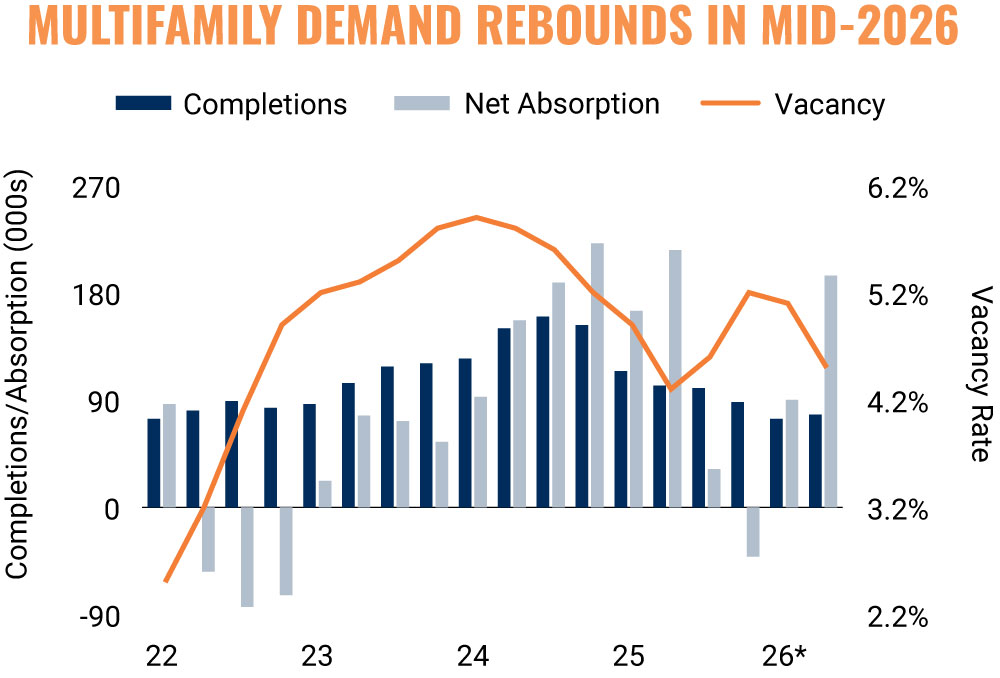
* Through June Sources: Marcus & Millichap Research Services; Bureau of Labor Statistics; CoStar Group, Inc.; Federal Reserve; Real Capital Analytics; RealPage, Inc.; University of Michigan
TO READ THE FULL ARTICLE