Research Brief
Inflation Resistance
June 2026

Analysis Reveals CRE’s
Inflation-Protection Potential
Quantifying CRE’s inflation hedge potential. A review of rent growth and CPI trends shows where CRE may offer stronger inflation resistance than the broader stock market.
- To test the relationship between rent growth and inflation, the analysis uses the Pearson Correlation Coefficient to measure how closely the two variables have historically moved together.
- The study covers a 25-year period for five main property types, while self-storage is limited to eight years of available rent growth data.
- Although the period includes only one major inflation surge, headline CPI reached the mid-4 percent range several times, allowing the correlation analysis to capture multiple spans of elevated inflation.
- Rent gains also reflect the influences of new supply, economic trends, and behavioral shifts on property performance, so the results should not be interpreted as proving direct causation.
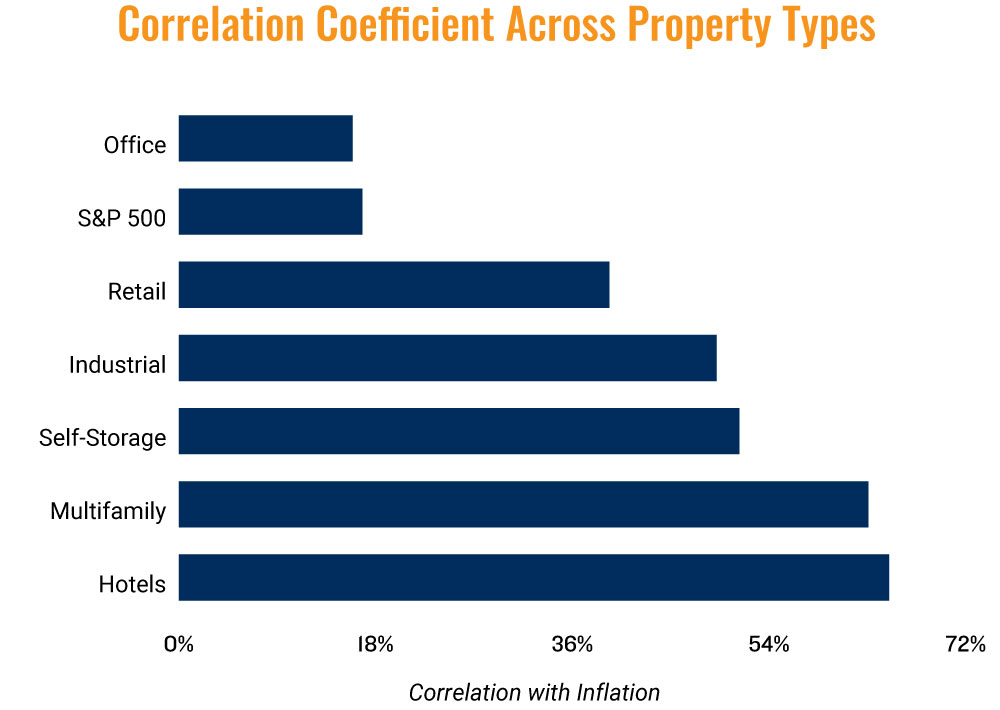
- As a baseline, the S&P 500 showed a low 16.8 percent correlation with inflation using the same methodology. However, other calculation methods yielded negative correlations, suggesting equities move independently of or inversely with inflation.
Inflation pass-through varies by property type. Lease length, contract terms, and demand shifts help explain why office, retail, and industrial rents show weaker-to-moderate links with inflation.
- Office properties showed the weakest relationship with inflation, with just a 15.9 percent correlation between rent growth and changes in CPI.
- Long office lease terms and limited use of rent escalators reduce responsiveness, while hybrid work has further weighed on aggregate rent growth over the past five years.
- Retail rent growth showed a stronger, though still modest, 39.4 percent correlation with inflation, partly because leases are more likely to include built-in rent escalators.
- Industrial rent growth had a moderate 49.2 percent correlation, supported by rent escalators that may be fixed to CPI.
- Based on the calculations, inflation explains roughly 24 percent of the variation in industrial rent growth, with R-squared measuring that explanatory power, placing it above the S&P 500 baseline but below the stronger CRE sectors.
Higher-correlation sectors stand out. Self-storage, multifamily, and hotels show the strongest inflation resilience, while the broader results support CRE’s role as a potential portfolio diversifier.
- Self-storage showed a 51.3 percent correlation with inflation, supported by month-to-month lease structures that allow rents to adjust more frequently.
- However, the self-storage result is based on only eight years of data, while pandemic-related demand shifts, elevated construction, and discounted street rates likely also influenced the relationship.
- Multifamily properties showed the second-strongest relationship, with a 63.1 percent correlation.
- Apartment leases are usually annual, allowing rents to reset more frequently than with office, retail, or industrial leases, which generally have longer terms.
- Statistical analysis suggests inflation accounts for roughly 40 percent of multifamily rent growth movement
- Hotels showed the strongest rent-growth-to-inflation relationship, with a 65 percent correlation, reflecting daily rate adjustments, while about 42 percent of the variance in rent growth is statistically linked to inflation.
- Overall, stronger correlations across most major property types suggest CRE may offer more inflation resistance than equities and potentially other asset classes, especially in a prolonged elevated-inflation environment.
Sources: Marcus & Millichap Research Services; Bureau of Labor Statistics; CoStar
Group, Inc.; RealPage, Inc.; S&P Global; Yardi Matrix
TO READ THE FULL ARTICLE