Research Brief
Financial Markets
May 2026

Economic Uncertainty Pushes the Fed
into a Wait-and-See Stance
The Fed continues rate pause. Turbulent macroeconomic conditions led the Federal Open Market Committee to hold the overnight lending rate steady at the lower bound of 3.5 percent at its third meeting of the year. The FOMC maintains that the current rate aligns with its dual mandate. However, committee members remain open to future adjustments as warranted by incoming data. Most Wall Street participants continue to believe that no rate change will occur this year.
Factors that weighed into the Fed’s decision. The Middle East conflict continues to restrict exports from the Persian Gulf, putting upward pressure on oil prices and downstream applications. As a result, core PCE inflation rose 3.2 percent over the 12 months ending in March. The Fed remains uncertain about the economic outlook as the conflict remains fluid. Regarding its second mandate, the unemployment rate stood at 4.3 percent in March and has changed little in recent months. However, diminished immigration and labor force participation may be keeping the rate artificially low. Many Americans still feel the impact of a softening labor market, as fewer job openings and exits have led to an overall more stagnant hiring landscape.
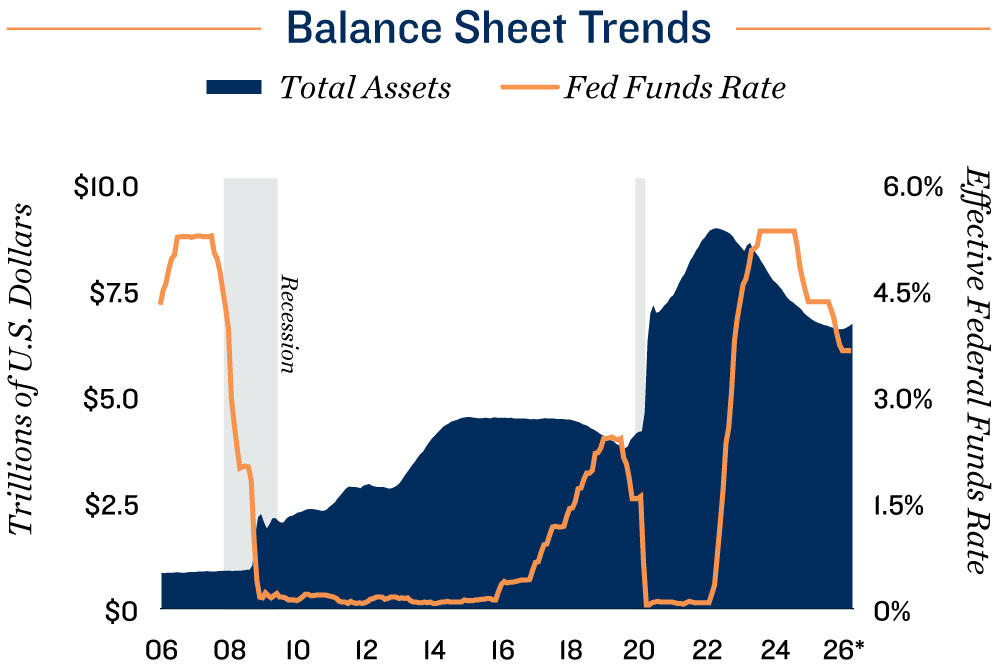 Leadership transition may bring policy changes. With Fed Chair Jerome Powell stepping down on May 15, Kevin Warsh moved closer to confirmation as the Senate Banking Committee advanced his nomination. If confirmed, Warsh has outlined key policy shifts, including shrinking the balance sheet to reduce the Fed’s footprint on the market and its reliance on quantitative easing. Warsh wants to return to a traditional rate-based monetary policy, arguing that the interest rate tool is more effective and equitable. However, execution will be challenging because the financial system relies heavily on abundant reserves, and previous efforts have triggered market disruptions. The nominee also seeks to either eliminate or significantly reduce the use of forward guidance, a tool the central bank uses to communicate likely future paths for short-term rates. Warsh contends that forward guidance limits the Fed’s flexibility by anchoring policy to prior communications rather than incoming data.
Commercial Real Estate Implications
Borrowing costs may rise in the near term. If Warsh can execute his goals, the Fed will begin actively selling its Treasurys and agency mortgage-backed securities, a more aggressive approach than the passive runoff under Powell. In the near term, this balance sheet reduction would keep the 10-year Treasury elevated, preventing CRE debt costs from falling. Any rate cuts could provide some relief for floating-rate borrowers, but fixed-rate financing could remain costly, as the long end of the curve stays sticky.
A more disciplined market. In the long run, as the balance sheet reduction runs its course and rate cuts become the primary tool, downward pressure on the 10-year should ease CRE debt costs. If executed properly, the payoff is a more disciplined market, where deal underwriting is less influenced by risks from a large balance sheet or an artificially low-cost debt environment. All else being equal, this will create a more sustainable foundation for CRE investment.
3.2% |
4.36% |
|
Core PCE Inflation as of March 2026 |
10-Year Treasury Yield on May 6, 2026 |
* As of April 2026
Sources: Marcus & Millichap Research Services; CME Group; Federal Reserve; U.S. Bureau of Labor
Statistics; U.S. Department of the Treasury
TO READ THE FULL ARTICLE