Research Brief
Hospitality Outlook
March 2026

Multiple Forces Foster Complex
Outlook for Hospitality Assets in 2026
Growth slows after strong recovery. Post-pandemic gains in occupancy, pricing, and revenue have cooled as macro uncertainty and elevated supply growth weigh on demand.
- In 2025, trade uncertainty, enhanced immigration enforcement, and slowing job creation pressed on demand, softening occupancy, particularly in the limited-service segment.
- ADR, on the other hand, has continued to rise, though RevPAR has largely flattened out.
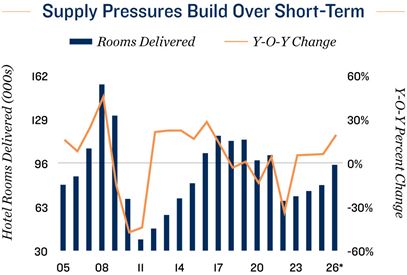
- Supply additions intensified competitive pressures, with roughly 75,000 rooms delivered nationally in 2024 and nearly 80,000 added in 2025.
- High-development markets such as Austin, Nashville, Salt Lake City, Phoenix, and Atlanta saw more pronounced performance impacts from elevated construction activity.
- In contrast, low-development metros, including Orange County, Cleveland, San Francisco, Minneapolis St-Paul, St. Louis, and Chicago, recorded strengthening occupancy.
- The development wave is expected to peak in 2026 with roughly 95,000 new keys delivered, extending near-term pressure.
- Full-service hotels have exceeded the general trend, supported by healthy business travel, which should carry into 2026.
- As construction slows beyond 2026, easing supply risks should allow the market to rebalance amid modestly weaker demand.
Cost dynamics reshape market activity. Changing asset values have altered the investment landscape, reinforcing constraints on new supply while supporting market liquidity.
- Pricing recalibration may also reduce development feasibility, as many hotels trade below replacement cost, favoring acquisition and renovation over ground-up construction.
- Private investors have led sales activity, accounting for nearly 75 percent of total hospitality deal volume in 2025.
- Cap rates for both limited- and full-service assets edged higher while borrowing costs trended lower, supporting a 14 percent increase in deal flow — concentrated in trades below $5 million.
Navigating near-term headwinds. Short-term pressures may influence performance in 2026, though disciplined supply conditions and eventual economic stabilization provide optimism.
- Elevated uncertainty from geopolitical conflict and changing U.S. policies are likely to impact both leisure and business travel demand
- Sustained increases in fuel costs could pressure travel activity during the summer season, weighing on hospitality performance over the short run.
- Higher air travel costs may alter vacation behavior, shifting demand toward drivable local and regional destinations.
- Despite near-term headwinds, constraints on new construction are expected to increasingly favor existing hotel assets.
- When uncertainty eases and job creation regains momentum, hospitality properties may be well positioned to outperform
| 61.8% 2026 U.S Occupancy* Down 50bps Y-O-Y | $161.8 2026 U.S. ADR* Up 0.8 Percent Y-O-Y |
* Forecast
Sources: Marcus & Millichap Research Services; Bureau of Labor Statistics; CoStar Group, Inc.;
U.S. Travel Association
TO READ THE FULL ARTICLE