Research Brief
Financial Markets
March 2026

Competing Trends and Uncertainty Leave
the Fed Funds Rate Unchanged
The Fed continues to pause on rate adjustments. February’s lackluster job report and the recent conflict in the Middle East led the Federal Open Market Committee to hold the overnight lending rate steady at a lower bound of 3.5 percent in its second meeting of the year. Despite concerns about rising inflation pressures and job losses, the FOMC maintains that the current rate aligns with its dual mandate. Among major concerns, the Fed released its most recent Summary of Economic Projections (SEP), which showed that officials held firm on a median forecast for one rate cut this year. Wall Street participants, however, now view the most likely outcome this year to be no rate change.
Oil supply shock in the Middle East adds upside inflation risk. Conflict between Israel, the United States, and Iran halted production and transportation of oil and liquefied natural gas in the Persian Gulf, where about 20 percent of the global supply originates. This disruption sent the Brent crude oil price per barrel up nearly 50 percent from its pre-conflict level, sparking a spike in petrol prices that could bleed into other goods. The Fed anticipates this crisis to remain a short-term shock but has considered the possibility of a protracted conflict and the resulting push on long-term inflation. Such an outcome would delay an expected Fed rate cut beyond 2026 and could instead lead to a rate hike. Meanwhile, Board members increased the median projection for both PCE and Core PCE inflation to 2.7 percent for 2026, anticipating how the energy market disruption will affect official inflation metrics.
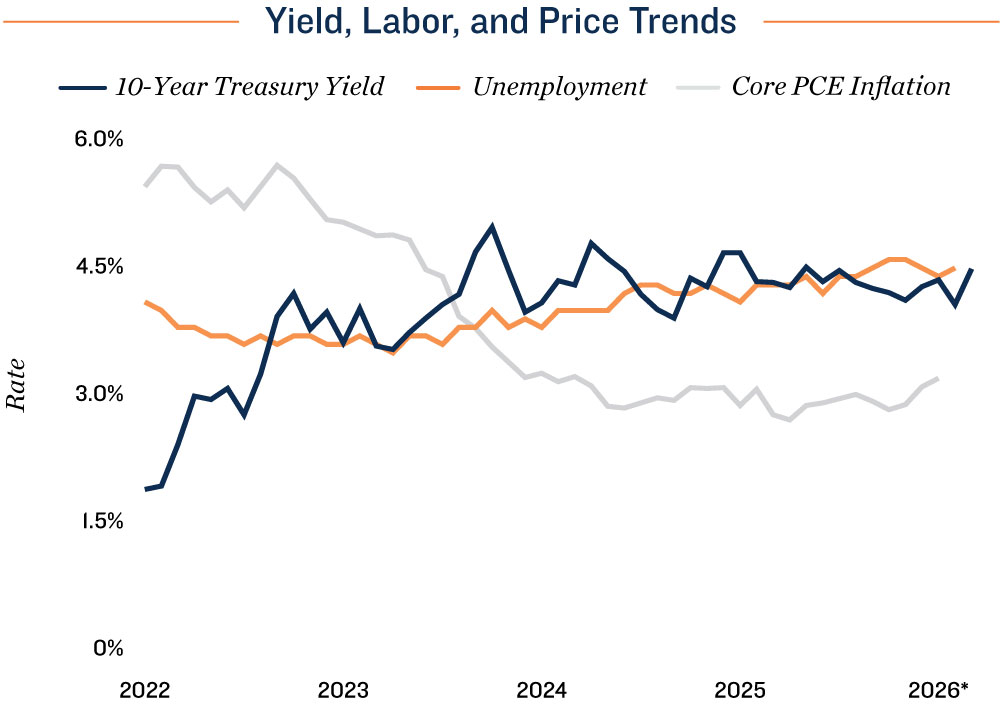 Employment decline heightens rate policy tension. The U.S. economy recorded a net loss of 92,000 nonfarm payroll jobs in February 2026, with most of the losses in the private service sectors. A rise in the unemployment rate to 4.4 percent now aligns with the FOMC’s projected median unemployment rate for the end of 2026. While this abrupt loss increases pressure on the Fed to cut rates further, inflation uncertainty keeps rate adjustments on the back burner. Monetary easing also typically takes several quarters to filter through to hiring, credit formation, and business investment, meaning the impact on the labor market from rate cuts late last year may still be lagging.
Commercial Real Estate Implications
Rising cost pressures shape capital markets and construction. Inflation uncertainty is driving up the 10‑year Treasury, which has risen roughly 40 basis points to 4.39 percent since the end of February, likely raising the cost of new CRE debt issuances. At the same time, higher oil prices could increase construction costs, potentially constraining future development pipelines if the conflict drags on. Although tax reform last year should boost take‑home pay for lower‑income households, rising fuel costs may still force consumers to shift spending toward transportation, impacting retail sales
Recent job losses could slow household formation and migration. Employment declines can slow housing absorption, adding to the challenges for markets already facing increased new supply. In self‑storage, economic strain may temporarily lift demand as households downsize, consolidate, or relocate. However, reduced mobility and slower household creation could ultimately restrain broader leasing momentum.
3.1% |
4.39% |
|
Core PCE Inflation as of January 2026 |
10-Year Treasury Yield |
* 10-year Treasury yield as of March 24, unemployment rate as of Feb. 2026, inflation as of Jan. 2026.
Sources: Marcus & Millichap Research Services; CME Group; Federal Reserve; Freddie Mac;
Moody’s Analytics; U.S. Bureau of Labor Statistics; U.S. Department of the Treasury;
U.S. Energy Information Administration
TO READ THE FULL ARTICLE