Research Brief
Canada Inflation
March 2026

Inflation Cools as Canada’s Commercial Real
Estate Market Finds Its Footing
Price pressures remain on downward trend. Canada’s inflation rate cooled further in February, reinforcing the broader disinflation trend underway. Headline CPI rose just 0.1 per cent monthly, while favourable base effects tied to last year’s GST holiday pushed the annual rate down 50 basis points to 1.8 per cent. Aside from a modest rise in transportation costs — mainly due to rising oil prices ahead of the escalating Middle East conflict — price pressures across most categories eased. The Bank of Canada’s preferred core measures slowed further, with the three-month annualized pace dropping to roughly 1 per cent. Although core inflation now seems on track to return to the Bank’s 2 per cent target sooner than expected, rising tensions in the Middle East present an upside risk, as higher oil prices could reintroduce energy-driven inflationary pressures in the months ahead.
Recent economic data has shifted the outlook for monetary policy. Cooling inflation, combined with a weakening economic backdrop, had been building a case for further easing by the Bank of Canada. Employment dropped by more than 100,000 positions over the first two months of 2026, fourth-quarter GDP contracted, and first-quarter growth is tracking near 1 per cent annualized — well below the Bank’s earlier 1.8 per cent forecast. Normally, this combination would strengthen the case for rate cuts. However, the escalating conflict in the Middle East, which has driven energy prices higher, has likely tempered those expectations. Even so, with economic momentum slowing, the prospect of rate hikes — as some market pricing currently implies — seems unlikely
Commercial Real Estate Outlook
Swings reshape lending conditions. Bond markets had been trending toward greater stability before the Middle East conflict. As inflation cooled and economic indicators softened through 2025, Government of Canada bond yields gradually fell, with the five-year note hovering around 2.75 per cent through much of the second half of last year. Yields briefly increased in early 2026 but then retreated following weak labour market and GDP data, reinforcing expectations that the policy rate had likely peaked, which was helping restore investor confidence. That stability was disrupted in early March as escalating conflict in the Middle East pushed oil prices higher and lifted inflation expectations, sending the five-year yield back above 3 per cent. While mortgage spreads have remained fairly stable, lenders may start pricing in higher risk amid economic uncertainty.
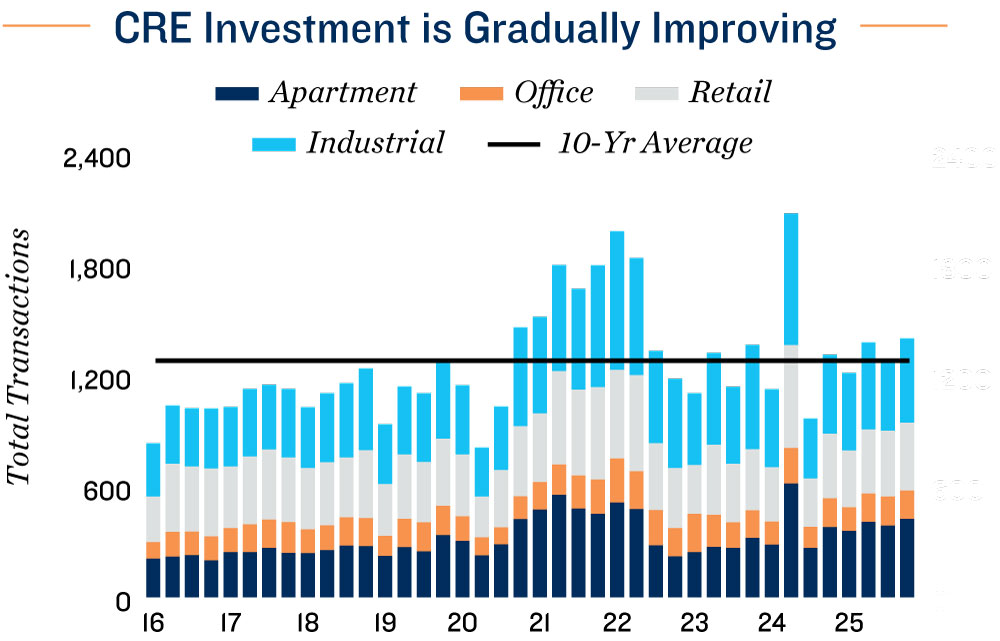
Investor confidence returning. Commercial real estate investment strengthened in 2025, with both sales counts and dollar volume surpassing their trailing 10-year averages by the fourth quarter. The improvement was mainly driven by greater interest-rate stability, which helped underwriting conditions and narrowed bid-ask spreads, alongside gradually improving property fundamentals and easing supply pressures. Looking ahead, sales activity is expected to continue recovering through 2026 as borrowing conditions improve and investors remain drawn to real estate’s stable cash flows and defensive qualities amid global uncertainty. However, the escalating conflict in the Middle East — and its potential impact on inflation and bond yields — remains a key risk that could slow the recovery.

* Through February
Sources: Marcus & Millichap Research Services; Altus Data Solutions; Capital Economics; CoStar
Group, Inc.; Oxford Economics; Statistics Canada
TO READ THE FULL ARTICLE