Research Brief
Trade Policy & GDP
February 2026

Trade Policy Shifts, Fiscal Uncertainty
Cloud 2026 Outlook
Supreme Court ruling eliminates IEEPA tariffs. The Supreme Court’s February 20 ruling in Learning Resources, Inc. v. Trump held that the International Emergency Economic Powers Act (IEEPA) does not authorize the executive to unilaterally impose tariffs. In response, the administration imposed a 10 percent global surcharge under Section 122 of the Trade Act of 1974, with a likely increase to 15 percent in the coming days. While this authority is capped at 15 percent and expires after 150 days, it is unclear if the executive can restart the clock via successive orders. Under this framework, the average effective tariff rate is projected to settle between 12 percent and 14 percent—down from the previous 16 percent—as the new order replaces higher duties previously applied to China, Brazil, and non-USMCA imports from Canada and Mexico.
Uncertainty remains elevated as the refund question looms. The Court’s decision to invoke the “major questions doctrine” suggests that trade actions of such vast economic consequence require a clear mandate from Congress. This shift effectively brings the judicial and legislative branches back to the center of tariff policy. Over the longer term, this increased oversight could reduce trade-related uncertainty by forcing the administration to rely on more transparent, investigation-based tools that offer predictable timelines and narrower scopes. However, the resolution of the approximately $175 billion of invalidated duties remains undetermined. While these funds are technically eligible for reimbursement, the lack of an administrative roadmap suggests a protracted recovery. These repayments should not be viewed as a reliable source of near-term economic stimulus.
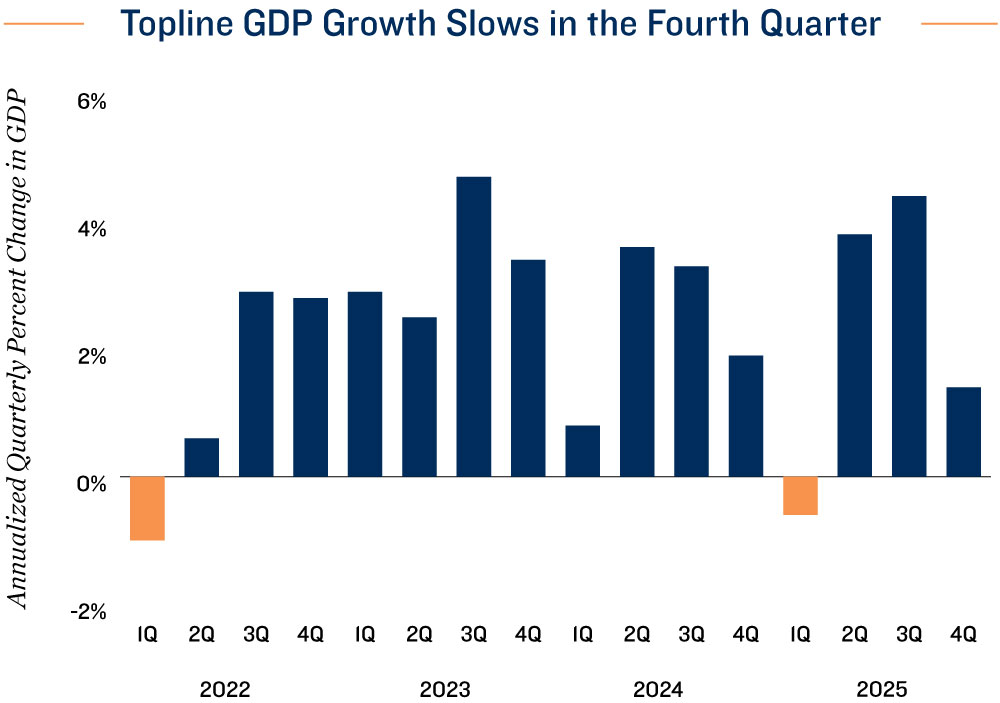 Fourth-quarter GDP growth tempered by government shutdown. The U.S. economy expanded at an annual rate of 1.4 percent in the final quarter of 2025, a sharp deceleration from the 4.4 percent growth recorded in the third quarter. This slowdown primarily reflected a 0.9 percentage-point reduction in government spending due to the 43-day federal shutdown. While business investment in artificial intelligence remained a key growth contributor, broader pullbacks in personal consumption and exports restricted full-year growth to 2.2 percent. Although a first-quarter rebound is anticipated as federal activity normalizes, persistent tariff-related uncertainty continues to cloud the outlook for a sustained recovery.
Commercial Real Estate Implications
Industrial vacancy continues to rise. Although the administration cites domestic manufacturing growth as a primary justification for trade barriers, industrial demand for warehousing and production space only modestly improved throughout 2025. The nationwide vacancy rate reached 7.8 percent by year-end — the highest level since 2013 — and is projected to climb to 8.4 percent by the end of 2026. This trend suggests that a broad shift in tenant demand due to tariffs has yet to materialize. Furthermore, the legal uncertainty following the Supreme Court ruling, combined with the 150-day expiration of the new 15 percent tariff, likely discourages long-term capital commitments required for reshoring activities.
Retail properties could face near-term headwinds. Fourth-quarter GDP data showed that consumer spending on goods declined from the third quarter. Weaker spending trends may slow retail space absorption, and the transition to a 15 percent global tariff under Section 122 could further disrupt supply chains for discretionary goods. However, retail fundamentals remain historically tight, as the sector entered 2026 with a nationwide vacancy rate of 4.8 percent — well below
the long-run average. Furthermore, the marginally lower average effective tariff rate following the Supreme Court ruling may provide a slight cost reprieve for certain tenants, potentially helping to offset operational hurdles in the coming months.
Sources: Marcus & Millichap Research Services; Bureau of Economic Analysis; CoStar Group, Inc.;
The Budget Lab at Yale; Cato Institute.
TO READ THE FULL ARTICLE