Research Brief
Canada Retail Sales
February 2026

Consumer Caution Persists, Yet Retail Property
Market Continues to Show Low Vacancy
Consumer spending ends the year on softer footing. Retail spending eased to close out 2025, with sales down 0.4 per cent monthly in December, led by a 1.6 per cent pullback at motor vehicle and parts dealers. Core retail sales slipped 0.3 per cent, as colder weather weighed on building materials and home-related categories. In price-adjusted terms, December was flat, highlighting still-cautious goods demand after November’s Black Friday rebound. For 2025 as a whole, retail sales rose 4 per cent, or 2.3 per cent in volume terms, supported by steady motor-vehicle activity and broad strength across general merchandise and health and personal care. Overall, 2025 reflected a consumer landscape shaped by sticky borrowing costs, trade-related uncertainty, and selective discretionary spending. Yet the year was resilient enough to generate moderate real growth.
Outlook marginally improves. December’s flat inflation-adjusted retail sales confirm that spending likely contracted in the fourth quarter, reinforcing views for another soft GDP print. With retail volumes down roughly 1 per cent annualized, overall consumption likely underperformed. This backdrop further lowers the odds of a 2026 rate hike and marginally strengthens the case for cuts if growth weakens. While a hold remains the base case, January job losses, softer fourth-quarter GDP, and waning goods demand highlight a consumer still constrained by high borrowing costs and ongoing trade uncertainty. Even so, the preliminary 1.5 per cent gain in January retail sales suggests a firmer start to 2026, with consumption potentially stabilizing as economic conditions improve.
Commercial Real Estate Outlook
Retail fundamentals hold firm despite market shifts. Canada’s retail property sector remained firmly resilient in 2025, extending the strong performance seen in essential-based formats. Even with vacancy rising 80 basis points following the closure of Hudson’s Bay and softer consumer confidence tied to trade uncertainty, vacancy remained exceptionally tight at 2.5 per cent nationally. Limited new supply continues to underpin fundamentals, as the under-construction pipeline stays scarce — further constrained by the broader slowdown in residential and mixed-use development. With constrained inventory, steady tenant demand, and its defensive nature, Canada’s retail property sector enters 2026 in a position of notable stability.
Industrial sector turning the corner. E-commerce was a bright spot in December, with online sales rising 3.6 per cent monthly to $4.3 billion, lifting the channel’s share of total online spending to 6.1 per cent, up from 5.8 per cent in November. This incremental shift toward digital spending continues to support Canada’s industrial sector, where leasing activity has shown early signs of stabilization after a slower first half of 2025. The national vacancy rate only increased 20 basis points in 2025 to 3.7 per cent. While elevated supply and softer goods
demand have eased pressure on logistics networks, sustained growth in online retail — paired with improved rate visibility — is helping firm up absorption across well-located distribution space. Overall, e-commerce’s steady expansion remains a key demand anchor, contributing to a more balanced and improving industrial market in 2026.

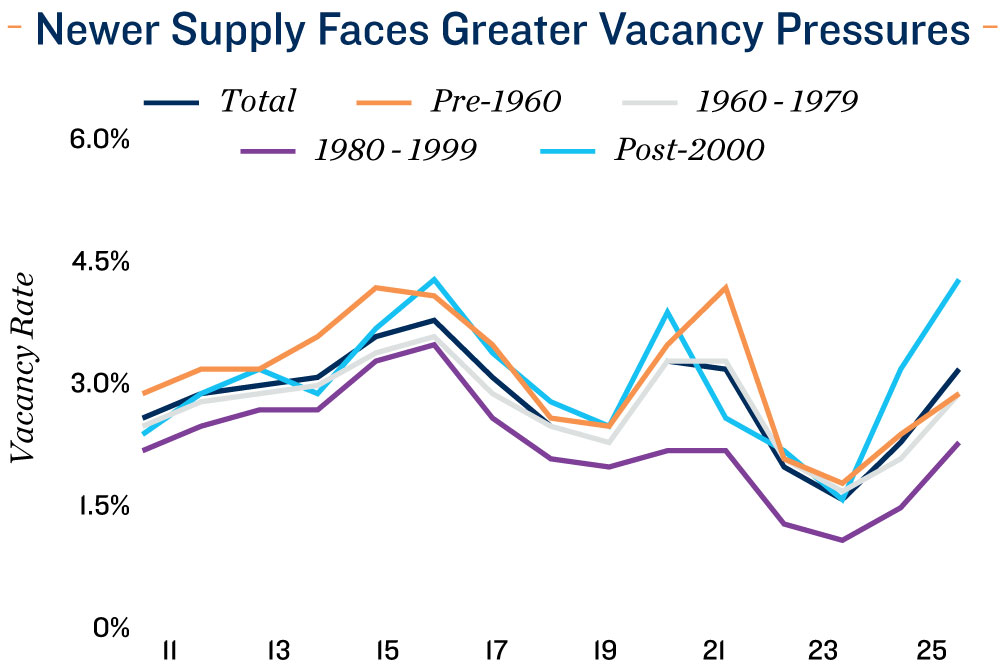
Sources: Marcus & Millichap Research Services; Altus Data Solutions; Canada Mortgage and
Housing Corporation; Capital Economics; CoStar Group, Inc.; Statistics Canada
TO READ THE FULL ARTICLE