Research Brief
Canada Employment
February 2026

Resilient Hiring Continues Amid Differing
Sector and Market Performances
Data suggests soft job market even as unemployment edges down. Canada shed roughly 25,000 jobs in January, while the employment rate edged down to 60.8 per cent, its first decline since last summer. Despite these job losses, the unemployment rate fell 30 basis points to 6.5 per cent amid a labour force contraction — participation slid 40 basis points to 65 per cent as fewer people actively searched for work. Sector-wise, manufacturing, education, and public administration led the job pullback, while information, recreation, business services, and agriculture posted modest gains. Wage growth also eased 10 basis points to 3.3 per cent year over year, reinforcing the picture of a labour market that is cooling, rather than overheating.
Softening data could nudge policy trajectory. January’s report reinforces the view that rate hikes this year are effectively off the table and may shift the conversation toward eventual easing. Job numbers came in well below expectations of a modest gain, and with fourth-quarter GDP now tracking flat to slightly negative, economic growth is clearly under pressure. The drop in the unemployment rate was also being driven by weaker labour force growth and lower participation, rather than robust hiring. At the same time, wage gains have eased and are broadly consistent with inflation
converging toward target. Taken together, these dynamics argue for a cautious central bank that keeps its policy rate on hold as the base case, while acknowledging that a run of softer data could justify additional cuts later in the year if the slowdown deepens.
Commercial Real Estate Outlook
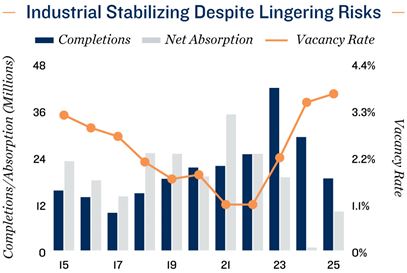
Industrial economy continues to feel pressure. Manufacturing shed about 27,500 jobs in January, with losses concentrated in Ontario’s industrial heartland, while transportation and warehousing declined by roughly 6,400 — sectors heavily exposed to shifting U.S. trade policy and USMCA renegotiations. Even so, Canada’s industrial property market appears to be stabilizing. National vacancy rose only 20 basis points last year to 3.7 per cent, where it has held since June, and early 2026 estimates point to a slight decline. Roughly seven million square feet of net absorption in the final quarter underscores that occupier demand remains intact as rates ease and visibility improves. Still, renewed tariff shocks or deeper economic cooling could temper leasing momentum, particularly among export-oriented users.
Labour shifts signal a more selective CRE demand cycle. January’s data also points to a labour market recalibrating in ways that matter for commercial real estate. Participation fell sharply, as more workers stepped back from job searches — signalling softer household formation and near-term leasing caution in several consumer-facing sectors. At the same time, job intentions data show rising churn among permanent employees in industries exposed to U.S. demand, reflecting elevated uncertainty but also a willingness to move to higher-paying or more stable roles. This transition phase typically favours CRE segments tied to resilient employment drivers— such as essential services, select tech, and recreation-oriented users — while reinforcing the need for investors to focus on assets aligned with sectors demonstrating clearer growth trajectories.

* Through January
Sources: IPA Research Services; Altus Data Solutions; Capital Economics; CoStar Group, Inc.;
Statistics Canada
TO READ THE FULL ARTICLE