Research Brief
Employment
February 2026

After Steep Revisions Reset Payrolls Lower, Hiring Begins to Gradually Rebuild
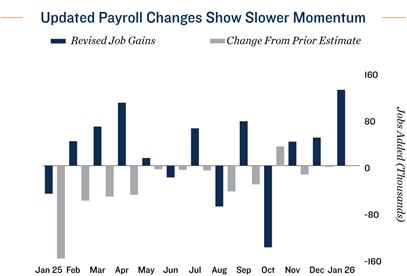
Employment growth firms despite 2025 revisions. Benchmark revisions underscored weak job growth in 2025, lowering the annual gain to 181,000 and resetting payroll levels lower by about 890,000 positions. The sharpest cuts occurred in trade, transportation, and utilities, down more than 300,000 jobs, with further losses of over 100,000 across wholesale trade, retail trade, and professional and business services. Notably, the largest adjustments clustered at the start of the year, indicating labor momentum was overstated entering 2025. January 2026 nevertheless recorded an uptick in hiring, and although early-year data can be volatile, the trailing three-month trend points to improving payroll gains. Even so, broader job growth and sustained wage gains will be key to confirming whether this momentum holds.
Private data helps confirm trends. January’s reported gain of 130,000 jobs nearly matches the revisions of the past two January releases, which were each revised lower by more than 130,000 jobs, raising the risk that this initial print is overstated. While adjustments to the Bureau of Labor Statistics’ birth-death model aim to better align estimates with real-time conditions and reduce future benchmark swings, uncertainty around seasonal factors and revisions may increase reliance on private payroll indicators. In January, ADP estimated just 22,000 private-sector additions — well below the BLS figure, though still an improvement over the mid-2025 declines. Bank of America’s internal payroll data also show the three-month average job growth rate rose to roughly 0.8 percent year-over-year in January, up from about 0.6 percent in December, alongside firmer small-business hiring late in the year, pointing to modestly improving conditions.
Slower labor supply weighs on urban rentals. Despite subdued job growth over the past year, the unemployment rate was 4.3 percent in January, indicating that slower labor-force growth is helping keep the jobless rate contained. This dynamic is beginning to appear in multifamily demand, with net absorption turning negative in the fourth
quarter for the first time in three years. Urban areas saw the steepest pullback in absorption and may be more exposed to weaker immigration inflows, as foreign-born residents account for about 22 percent of urban-county residents versus roughly 12 percent in suburban counties. This mix may leave suburban areas more resilient, particularly in markets where new supply is constrained.
College grads see unemployment rise. From January 2025 to January 2026, the unemployment rate has remained largely stable for workers with a high school diploma or less, while the rate for workers with a bachelor’s degree or higher rose by about 60 basis points, though it remains lower overall. At the same time, average hourly earnings in professional and business services were flat in January and up about 3.5 percent year over year, pointing to cooling wage growth in higher-income sectors. This mix could weigh on consumer spending, with retail sales growth slowing to a 2.4 percent year-overyear gain in December, the weakest pace since September 2024
Fed faces mixed signals. Strong January payroll gains led Wall Street to trim expectations for a June rate cut, with implied odds falling from roughly 75 percent to near 60 percent. As long as the unemployment rate and wage growth remain stable, the Federal Reserve is likely to keep policy restrictive. However, softer consumer spending
complicates that stance, and continued disinflation could give the Fed greater confidence to cut rates earlier if hiring proves less durable.
181,000 |
130,000 |
|
Revised Jobs Added in 2025 |
Jobs Added in January 2026 |
Sources: Marcus & Millichap Research Services; Bureau of Labor Statistics; CME Group; CoStar Group, Inc.;
Federal Reserve; Moody’s Analytics; Real Capital Analytics; RealPage, Inc.
TO READ THE FULL ARTICLE